Safety, Security, Health and Environment
Importance and Mission
At PTTEP, safety is one of our business principles under the aspiration to achieve zero incidents (Target Zero). A proactive safety culture has been instilled and emphasis is placed on personal safety of all workforce and process safety of our facilities. The Company implements the Safety, Security, Health and Environment (SSHE) Management System that is in line with our SSHE policy and complies with international standards and industries best practices, to ensure that everyone working with the Company returns home safely and that incidents are prevented to avoid causing impacts on stakeholders and the environment.
Vision
Zero Incident Organization
Mission
- 1 Prevent all incidents through proactive personal and process safety management.
- 2 Embed SSHE mindset and leadership at all levels toward a generative SSHE culture.
- 3 Recognize SSHE as a foundation towards competitive performance and innovation for long term stakeholders value creation.
Goals
- 1 Achieve zero incidents (Target Zero)
- 2 Maintain personal safety of all employees and contractors and process safety of all facilities
Management Approach
Safety, Security, Health and Environment Policy (SSHE)
SSHE is fundamental for PTTEP's business. To achieve and sustain excellent performance toward relevant Sustainable Development Goals (SDGs), we put in place and adhere to an effective SSHE management system in order to ensure the safety and health of everyone involved in our operations and communities where we operate, environmental protection and the security of our people and assets.
To achieve our vision of being a zero incident organization, PTTEP shall:
- Strive for a generative SSHE culture through accountable leadership and involvement of all employees and contractors.
- Set measurable objectives, KPIs, targets, and action plans to deliver top–quartile SSHE performance, which is a line management accountability.
- Fulfil compliance obligations with applicable SSHE laws, regulations, internal requirements, and national and international standards.
- Manage SSHE risks to As Low As Reasonably Practicable (ALARP) throughout the PTTEP business lifecycle and when Management of Change (MOC) is applied.
- Promote an effective health management system and enforce zero drugs and alcohol programs in the workplace.
- Reduce environmental footprints in alignment with low carbon pathway, circularity concept, and positive Biodiversity and Ecosystem Services (BES) value creation.
- Protect all employees and the organization from pandemics, natural disasters, security threats, and vulnerabilities by effectively managing emergencies, crises, and business continuity.
- Empower everyone to exercise Stop Work Authority (SWA).
- Commit to continuous SSHE performance improvement via regular training, stakeholder participation programs, and upgrading systems and tools with technology.
The successful implementation of this policy requires total commitment from PTTEP employees and contractors at all levels by being mindful in every action.
(Remarks: PTTEP SSHE Policy is annually reviewed by the SSHE Council and approved by the Chief Executive Officer (CEO), the Director and Secretary to the Board of Directors )Safety, Security, Health and Environment Management System (SSHE MS)
PTTEP's SSHE MS comprises of seven elements:
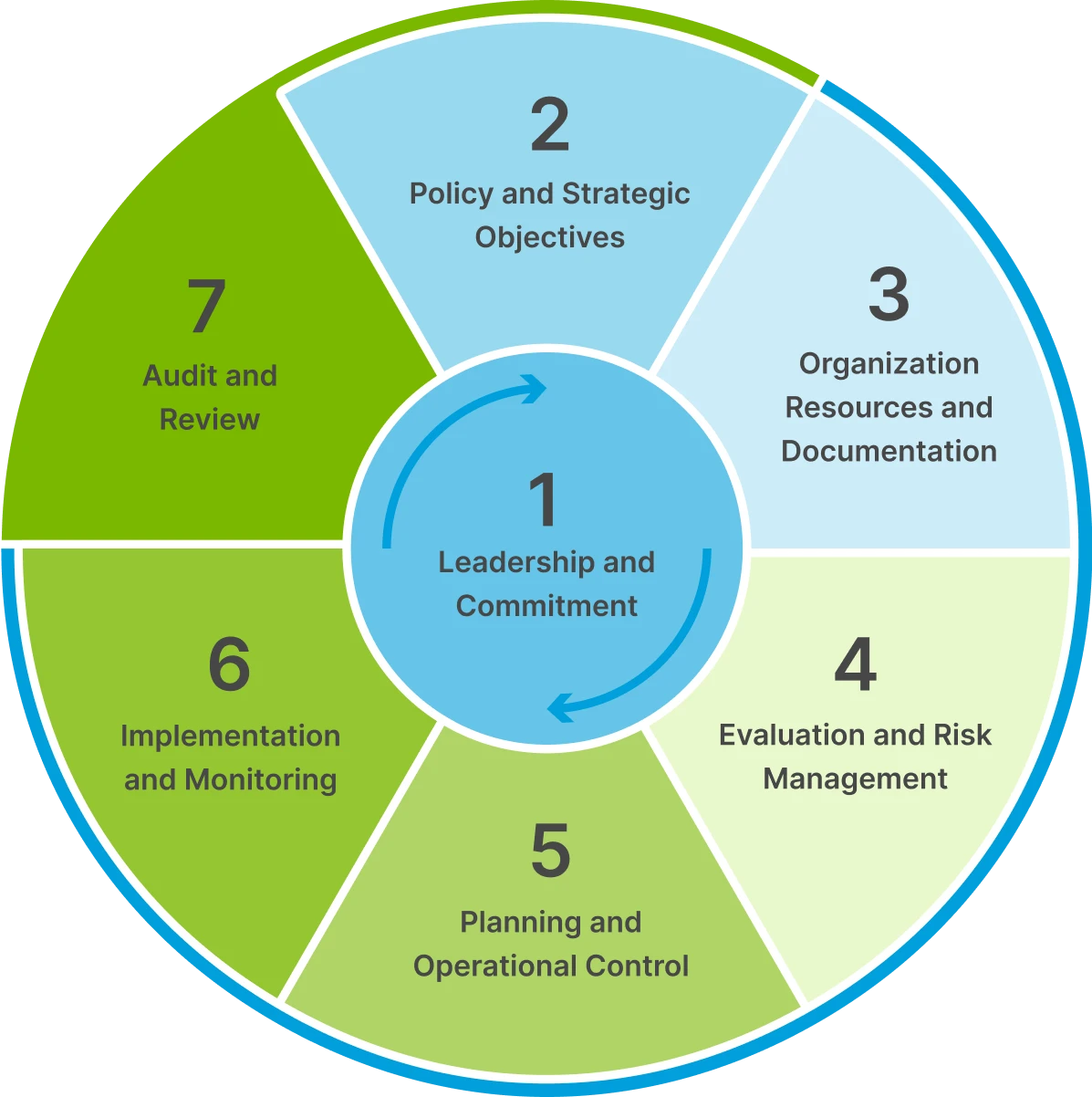
| SSHE Element | Addressing |
|---|---|
| 1. Leadership and Commitment | Top–down commitment and SSHE culture, essential to the success of the SSHE MS |
| 2. Policy and Strategic Objective | Corporate intentions, principles of action and aspirations with respect to SSHE |
| 3. Organization Resource and Documentation | Organization of people, resources and documentation for sound SSHE performance |
| 4. Evaluation and Risk Management | Identification and evaluation of SSHE risks, for activities, products and services, and development of risk reduction measures |
| 5. Planning and Operational Control | Planning the conduct of work activities, including planning for changes and emergency response |
| 6. Implementation and Monitoring | Performance and monitoring of activities, and how corrective action is to be taken when necessary |
| 7. Audit and Review | Periodic assessments of SSHE MS performance, effectiveness and fundamental suitability |
SSHE Culture Management
SSHE Culture development is essential for enhancing the SSHE performance of the organization. Since 2011, PTTEP has adopted the SSHE Culture improvement model based on the HSE Culture Ladder Model from the Energy Institute (EI), which identifies five levels of HSE culture, ranging from Pathological to Proactive.
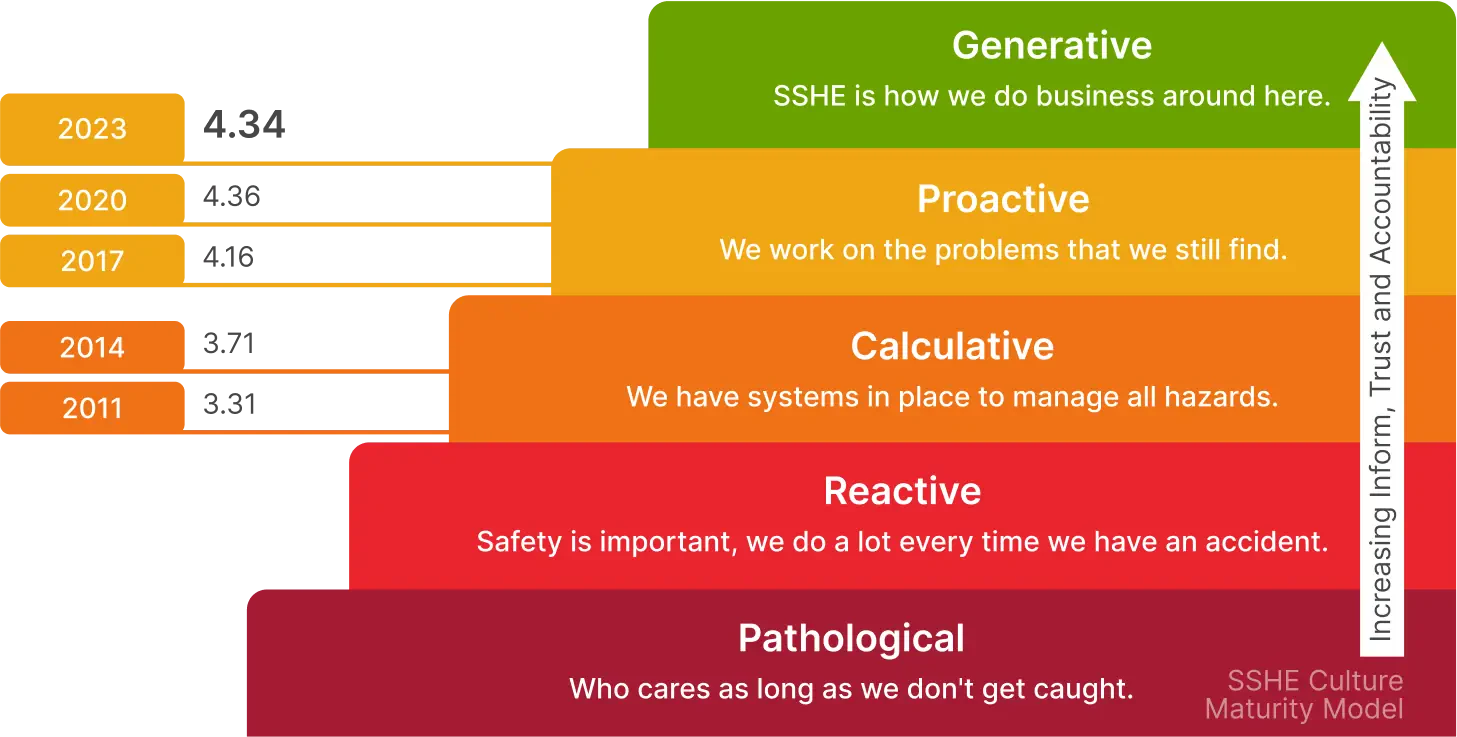
The SSHE culture survey is conducted every three years. Regarding the first SSHE culture survey in 2011, PTTEP's SSHE Culture Maturity level was 3.31 (Calculative level). As a result, the SSHE culture improvement plan was developed and implemented. In 2017, continuous improvement was demonstrated from the survey results, in which the SSHE Culture Maturity Level for PTTEP reached 4.16 (Proactive level) from the highest at 5.
The SSHE culture maturity level of the entire organization increased to 4.34 (Proactive level) based on the 2023 SSHE culture survey results, with no distinction between the results of top management and employees. Regardless of position, all PTTEP employees have the same level of SSHE awareness. In addition, mode 1 contractors were initially engaged in the SSHE culture survey in 2020. PTTEP expanded the scope of the SSHE culture improvement and development technique in 2022 to include mode 2 contractors performing high-risk activities, as detailed in the contractor safety topic.
PTTEP establishes a 3–year plan (2024–2026 SSHE Culture Improvement Plan) to strengthen its SSHE culture. Periodically, continuous monitoring will be conducted to ensure the improvement of the SSHE culture maturity level in all operating areas and the achievement of the objective of becoming an incident–free organization (Target Zero). The following SSHE culture survey is planned for 2026.
PTTEP expanded the scope of the SSHE culture improvement and development technique in 2022 to include mode 2 contractors performing high–risk activities, as detailed in the contractor safety topic.
Environment
PTTEP commits to operating business with social and environmental responsibility by adhering to the Safety, Security, Health and Environmental (SSHE) Policy, which integrates the commitment to environmental protection, regulatory compliance, and continuous improvement. Company personnel, business partners as well as contractors working for or on behalf of the Company must implement this SSHE Policy. The summary of PTTEP's Environmental Management appeared in the Company's website; Environment Section , such as